Sunday, February 13, 2011

Unnatural Deserts of the Flanaess

Forgotten City or bust!
I was involved in a forum discussion last summer about the lack of any natural deserts in the World of Greyhawk setting. Those fans who have followed Greyhawk since the 80's already know about this topic fairly well, but just in case, it goes as follows: All the major arid regions of the Flanaess have had some kind of magically influenced climate brought upon them in the past. A popular way of justifying this is to say that magic affecting the weather in the Flanaess is natural to a high magic setting. This is a fine in game excuse except as I have recently investigated, I now think the reason for all the magical deserts is due to emulating campaign development.

1st Edition (World of Greyhawk Folio and Boxed Set)
In the original published setting we have four major arid regions in the Flanaess (I won't get into Riftcanyon might be a fifth). The Sea of Dust, the Dry Steppes, the Bright Desert and the Barren Wastes. The Sea of Dust and the Dry Steppes of course are the leftovers of the Suloise and Baklunish Empires respectively after their Twin Cataclysms destroyed each other. This is the historical backbone that the campaign is built on as laid down by Gygax and there is no disputing these massive regions were magically created.

"History tells us that (the Sea of Dust) was once a fair and fertile realm extending thousands of miles west and southward, too."

"Once the (Dry Steppes) was well watered and fertile, forming the homelands of the Baklunish Padishahs and Sultans..."

What of the Bright Desert in 1st edition?

"The harsh climate, wildly varying temperatures, and hostile inhabitants...tend to discourage exploitation."

And the Wastes? Virtually no reference outside the Rovers of the Barrens hiding there time to time. This is what grabs me. In the early going we have two magic deserts and two natural ones. It would have to take a great leap of imagination to translate "wildly varying temperatures" as magically influenced back then. Moving on...

2nd Edition (Greyhawk Adventures, Rary the Traitor, Iuz the Evil, etc.)
Development on the setting moves forward. James Ward writes about the Burning Cliffs in the Wastes for the first time. From this section we learn about a possible magic origin for the Wastes:

"...the forests, marshes, and grasslands at the edge of the Wastes, hundreds of miles away, have begun to sicken and die, supporting the claims of some scholars that the Burning Cliffs are in fact responsible for the Wastes to begin with."

"A large town has grown up near the center of the conflagoration, where there is a gate to the plane of Fire. The wily Storich's boasts are true to the hilt; he passed through to the City of Brass itself..."

Ward goes to the magical gate theory and so the Wastes become in danger of losing its natural desert status. Then some years later, Iuz the Evil by Carl Sargent further elaborates on the creation of the Wastes. The wheels completely fall off this time and the Wastes are forever in the magical column.

"The origins of the Wastes are generally thought to be magical, with some natural, or most likely magical, cataclysm having created them much as the Sea of Dust was created, probably centuries before the Invoked Devastation."

It gets stranger...

"Other tales tell of a subterranean race of intelligent, magical reptilian creatures which employ magic to render the Wastes a wholly barren land to keep the surface folk from taking an interest in their affairs."

Then there is the Bright Desert. This completely untouched desert region got its first dose of Greyhawk development in the divisive Rary the Traitor by Anthony Pryor. Metaplot aside, he introduces good material on the climate and life of this previously undeveloped desert.

"Any desert is a harsh climate, and the Bright Desert is harsher than most. Located in a waterless bowl, with scant rainfall each year, the Bright Desert challenges even the hardiest wilderness survival expert."

Then Pryor introduces the ancient kingdom of Sulm and its rival Itar to give the area its place in the Flanaess' background.

"Once, over 2000 years ago, a Flannish kingdom called Sulm ruled the central portion of what is now called the Bright Desert. Constant warfare with desert nomads and internal unrest led Sulm's rulers to delve into forbidden magic and the worship of evil gods."

This quote is good in that it means there has always been some arid areas of the old Bright Desert. Perhaps Sulm's central region was a river cutting through the desert not unlike the Nile or Tigris. Of course this all goes to "waste" with the curse of the Scorpion Crown which turns all Sulmites into manscorpions and with it the fertile kingdom of Sulm vanishes from history. All is not lost though:

"If the crown is eliminated...the Bright Desert slowly begins to revert to a reasonably fertile, if somewhat arid region. There changes taken place over a century or more..."

So we finally have a natural desert with some fertile areas, that then falls into the same development hole and becomes affected by high magic and changed into a completely hostile desert region. At least Anthony gave the Bright Desert a little credit. Perhaps the reversion back to a fertile land is slow because natural desertification would have slowly ate it up anyhow even if Sulm hadn't vanished overnight. This is a good partial save for the Bright Desert to not be cataclysmically created by magic but rather maintained by it. 

What of the rest of Oerth? We now know of other arid lands beyond the Flanaess thanks to the Dragon Annual map and its highly controversial analogue nations. Here we have possible candidates for future natural deserts with places like Erypt and the Red Kingdom. The temptation for future writers, be they professional or fanbased, to make these undeveloped lands magically created or maintained will be great. After all they are following in the footsteps of Gygax and if destroying kingdoms and turning them into ash was good enough for him, why not try it again? 

Thursday, February 10, 2011

Fiction: The Mortal Life of Kostchtchie


Over at the Greyhawk fansite Canonfire, regular forum guru Rasgon has posted a short story (which I can only assume is written by him) about the mortal history of famed Demonlord Kostchtchie. The tale blends his Earthly historical myth with the more modern D&D milieu. It's quite a good read, check it out!

Monday, February 7, 2011

Ghost Tower of Inverness in 4e


A friend of mine from the Portland area who works closely with his local Wizards' D&D Encounters program, pointed out to me their newest storyline beginning on February 9th. I'm not sure of the official title, but it has something to do with a "Phantom Brigade." Cool so far. Now I've never paid much attention to D&D Encounters, but when he told me this one involves the Ghost Tower of Inverness well, you know I had to check into it. Note: I'll try to hold back on the scathing condemnation of 4th edition as much as possible. I mean, I do play in a 4e homebrew game, but this is about Greyhawk classics being used in organized play so expect a little edge to my words.

For those who aren't aware, D&D Encounters is done at organized sites, like game stores. It's advertised as such:

"D&D Encounters is an exciting, weekly campaign that plays out one epic encounter at a time. As you defeat enemies, solve puzzles, finish quests, and perform heroic deeds, you’ll earn Renown Points that you can use to get exclusive rewards. Each session only takes 1-2 hours to play, so it’s easy to fit your game in after school or work. And each week there’s a new and exciting challenge. Jump in anytime!"

Easy enough. Not everyone has the time and/or luck to have their own home campaigns. In my estimation, this Encounters biz is a direct offspring of Magic the Gathering leagues and Living Campaigns. What about the Ghost Tower? Their ad says:

"Over sixty years ago, a group of bold adventurers calling themselves the Silver Company delved into a mysterious tower that appeared in the ruins of Castle Inverness. The result was tragic."

 That sounds like the Ghost Tower I know!

"Now, six decades later, an ambitious young cleric named Aldus Splintershield seeks to make a name for himself and his clan by founding a new town in the ruins of the infamous castle. And so he has hired you, brave adventurers, to guard against whatever perils may arise from such an expedition."

Hm. So its set in the ruins of Inverness, but not necessarily the Ghost Tower. I wouldn't bet against it though, because as D&D Encounters is a series of weekly, um, encounters then the story would awful bland if it was one attack after another in the same location. It is good to see that it isn't a rehash so much as a storyline extension of the original, sans any Greyhawk reference of course.

"So prepare yourself and guard against the worst. For in the Nentir Vale, the worst is always on the way."

The Nentir Vale as best as I can guess is the default world of D&DE. Is this the fate of Greyhawk material in 4th edition? To be dropped piece by piece into new settings such as Nentir Vale? Possibly, but more on that later. The organized play enticements are more eye-popping to me. Remember, I do play in a 4e campaign and in a game store no less. Yet, if I had to play it through D&DE each week, I'm not sure I'd be able to stick around for long. It's too many new tricks for this old dog:

First off there is the new Fortune Cards that Wizards is pushing for organized play (It's optional for home use otherwise). It looks like a must have if you're playing in D&DE. In fact, I'm fairly sure its a requirement in some cases to participate at stores. You build a deck of 10-30 cards (note that boosters are 8 cards each, you can do the math) and so it goes you draw a new card each round for some random element that can be played in combat.

" These cards give characters fun, temporary benefits that feel different from the benefits gained from powers and feats, without adding undue complexity to the D&D game."

As most 4e combats I've been privy to run longer than 10 rounds, you'll need plenty of fortune cards. As for complexity, 4e is already rife with complex feats and powers, so 10-30 more one-shot powers shouldn't be too much more to buff a character right? Okay, how about a buff for the buffs? Yes, there is also something called "Twitter Buffs" that further add complexity to the Fortune Card buffs. I kid you not.

"Every week, Dungeons & Dragons® Encounters™ brings new adventure. And every hour, D&D’s @Wizards_DnD Twitter Channel brings you a new way to interact with your game. Get your D&D Fortune Cards ready and watch for tweets that will bring the two together.
Twitter Buffs will allow you to do even more with your D&D Fortune Cards—follow @Wizards_DnD"

Okay then! So now those with their smart phones handy at the game table can keep checking for special buffs while they wait for their character's next turn. I can barely stand that kind of distraction in home play but if it's integrated into play? Yikes. But that's not all! There is also Rewards and Renown Points.

"Players, as you progress through each season, you’ll earn Renown Points you can use to get exclusive Fortune Cards. Dungeon Masters, as a way of thanking you for your invaluable work, you’ll get exclusive game aids you can’t find anywhere else."

That's correct, earn points for a chance to earn more cards to improve your character so that he can earn more points and so on. That's incentive enough for the journeyman gamer. Hey and bring in a new player for 2 extra points! Wizards has this down to a science.

Anyhow, gripes about collectable card games aside, the parting out of Greyhawk in 4th edition continues. But really, it's only come full circle if you think about it. Sure, Greyhawk was originally Gygax's homebrew world but a lot of the classic mods that we associate with the published version were at first tournament modules written by other authors, that got pieced together into a nascent world that became 1st edition Greyhawk. So the fact Greyhawk classics like Inverness may be seeding new storylines in 4th edition is fine in essence. Greyhawk icons have stood the test of time and its easier to revisit those than create new ones. But from a setting legacy standpoint, there has to come a time when the Greyhawk is given the spotlight again, or else the next generation of gamers, whom I assume Wizards targets with programs like D&D Encounters, may never know that their favorite adventure spots, like Inverness started not with Nentir Vale but another obscure fantasy world.

Update: 4/25/2021: I added a link to the 4E adventure now only available on DMsGuild.

Wednesday, February 2, 2011

Greyhawk Rugby League!

Anyone who knows me well, knows I am quite a sports-maniac. This mania has even leaked into my D&D gaming. With that said, in honor of this year's Superbowl, I have gone into my Greyhawk Archives to find my notes on a rather unique period from my "Silver Age" 2nd edition campaign. Back in the 90's we gamed heavily around Greyhawk City; exploring Greyhawk Ruins, putting down the Temple of Elemental Evil and playing medieval rugby. Say what, you ask? Rugby in Greyhawk? Yes! It is slightly canonical too:

(Free City Arena) "About 200 years ago, Lord Mayor Zagig Yragerne and the newly founded Grey College joined forces to build a great arena in which student assemblies, sporting events, public entertainment, and so forth could be held."


"The arena can seat about 18,000 people, most such gatherings being for inter-school sports and competitions. Grey College, the Bardschool, the School of Clerkship, the University of the Flanaess, and low ranking wizards from the University of Magical Arts are joined by independent fraternities, sororities and other student groups representing the minor schools in these games."


"The oval field (shaped that way to accommodate certain "long-field sports" played by two teams) is usually hard-packed sand, but rolls of grassy turf can be laid over it..."


(University of the Flanaess) "..the student body is lively and loyal and it does well against Grey College in team sport."


(School of Clerkship) "The school does not do well in athletics against Grey College (or even small schools)..."


"The faculty, staff, and students of Bardschool have a friendly rivalry with Grey College and compete against that facility in sports and other events."


In 629 CY (Our timeline always ran far ahead of canon), a group of PCs settled down in Greyhawk City and with the great wealth from their adventures, began a "Guild of Adventurers" to combat what they felt was unfair practices of the Mercenary's Guild and several other  city institutions. Their hall was nicknamed the "Brothers in Arms" and was friendly to all civilized races, classes and religions. The actual reason behind them joining the inter-city rugby league is unknown, but I'm sure it was to boost the popularity and membership of their new organization.


As I designed, the current G.R.L. had been going on nine years before the Brothers in Arms came along, so a quick recap of the previous seasons was needed to show where the various teams stood. The G.R.L. consisted of:

University of the Flanaess "Griffons" (blue & silver) Av. fan attendance: 10,000. Active 620-633 CY
University of Magic Arts "Lightning Bolts" (red & gold) Av. fan attendance: 5000. Active 620-632 CY
Grey College "Greyhawkers" (black & grey) Av. fan attendance: 10,000. Active 620-633 CY
School of Clerkship "Clerks" (brown & gold) Av. fan attendance: 500. Active 620-628 CY
Bardschool "Poet Heroes" (green & gold) Av. fan attendance: 2000. Active 620-633 CY
City Watch "Watchmen" (red & blue) Av. fan attendance: 5000. Active 620-633 CY
Adventurers Guild "Brothers in Arms" (blue & gold) Av. fan attendance: 5000. Active 629-633 CY
Dyvers College "Lakemen" (blue & black) Av. fan attendance: 1000. Active 633 CY

The Adventurers' Guild replaced the School of Clerkship who had tired of getting beat on year after year. Dyvers College was invited in to replace the University of Magical Arts, who dropped out because of a subplot involving the High Ring (more on them another time). This league wasn't just a lark, there were other subplots between the schools (and the corrupt City Watch team) and recruiting to be done each year (much akin to hiring henchmen) as well as player tampering I am sure. Then there was the inevitable after-game parties and brawls at Gnarley House. The only thing my memory is sketchy on is how these games were actually played out (for the PC's team at any rate), but I do remember having some sort of system because some of their own players were involved and they had created set-plays. Once again, in hindsight I wish we had played Bloodbowl for the G.R.L. it would've worked perfectly! Sure we knew about Bloodbowl but for some reason were against playing it back then. Naturally, a decade later I got into playing Bloodbowl quite heavily, both table top and online, even going as far to play in a tournament at Gencon one year (the Ratanapolis Revolt). Maybe next time. In any event, I hope this post inspires other Greyhawk fans who like sports to take a break from the dungeon-crawl and do something similar.

Saturday, January 29, 2011

Virtuosos of Villainy: Eli Tomorast


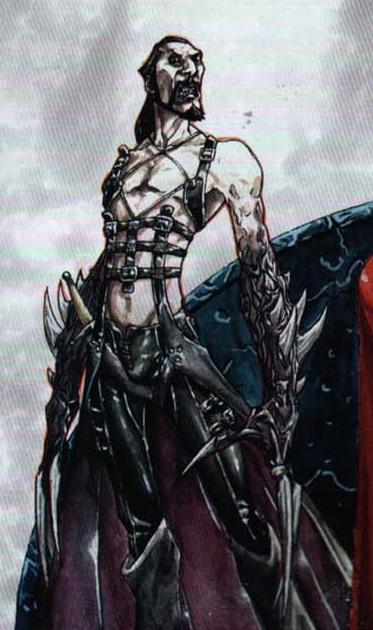
Few villains in all my home Greyhawk campaigns have struck a nerve with players as much as Eli Tomorast. Tomorast is one part Freddy Krueger, one part Belloq from Raiders of the Lost Ark, a dash of Pinhead from Hellraiser all mixed together in a Greyhawk pot. All of this is what makes this diabolical, demon-clawed mage my favorite villain of all time. Unlike many module villains however, Eli Tomorast has a rich back story to match his evil appearance, as well as the perfect base of operations to conduct his plots: the dungeons of Maure Castle

Background: Eli was created by Robert J. Kuntz and Gary Gygax to be the main antagonist for the AD&D module, WG5 Mordenkainen's Fantastic Adventure. Based on Kuntz and Gygax's home campaign, this module retells the early exploits of the Citadel of Eight (Gygax's own character, Mordenkainen for instance is only 12th level.) as they go beyond the "Unopenable Doors" and discover one of the most difficult challenges of their careers in Eli Tomorast. Though he is ultimately meant to fall to the heroes, his evil was too good to stay dead for long. Tomorast made his triumphant return in the Dungeon Magazine #112 mega-adventure Maure Castle cowritten again by Kuntz. This epic dungeon-crawl greatly expounds upon previous material and delves further into the background of this evil character.
 
Tapestry depicting the Lost City of the Elders.

Eli Tomorast is a renegade Seeker of the Arcane (a group of scholarly explorers and treasure hunters) who allegedly destroyed their chapter house in Highfolk. It is also known that Tomorast earned the enmity of the Silent Ones of Keoland. Possibly hiding from his peers, Eli first set up shop in the dungeons near ruined Maure Castle around 550 CY. A diary found in this lair reveals his previous expeditions including one to the Forgotten Temple of Tharizdun where he learned dark secrets from its priests, and more recently a place of myth he stumbled upon called the Lost City of the Elders. It is here, Eli gained his signature hand-grafts and captured a particularly nasty guardian demon named Kerzit. Evidently Tomorast strongly desires to return to this otherworldly place again, and much of his work below Maure Castle might have been towards this goal.


Powers: Tomorast is a billed as a wizard, artificer and madman. He is responsible for creating many magic objects, most of which are deliberately cursed. The worst of his creations however come from the pages of his Tome of the Black Heart, an evil book he chanced upon in a curio shop in Greyhawk City. This includes the rituals to summon and bind the demon Kerzit and the plans to create the Terrible Iron Golem. 

Where most evil wizards would be happy just hiding behind minions and flinging spells into combat, Tomorast shows off his most sadistic, intimidating side: his demonic hands. Eli likely gained these profane appendages during his visit to the Lost City. Who they belonged to and what deal he made to gain them is unknown (though I speculate they are originally part of Kerzit). What is known about them is their horrible melee and magical effects. 
Eli's claws and spikes are as deadly as any fighter's blade and he takes delight in using them to shred other spellcasters apart instead of using spells. And while he does have a full compliment of killing spells at his disposal, the demon hands have other inherent powers to make Tomorast an even more tenacious opponent. His left hand can boost his dexterity and armor class, while the right hand improves his chances to hit with held weapons (however he accomplishes that!). Should both hands hit the same target in melee, the poor victim can end up paralyzed and possibly lose a level! Defensively, when Tomorast's hands are clasped, his armor class and saving throws are improved, plus he gains some healing. Yes indeed, a fight with Eli Tomorast is like none other.

Eli in the Home Campaign: As I mentioned before, Tomorast has earned a special place of hate in the memories of my friends. We never played WG5 with the pre-generated characters from Gygax's game, Mordenkainen, Bigby the mage, Riggby the cleric and Yrag the fighter. Using our own characters they faced the same dangers and came to the same results, battling and running from the Terrible Iron Golem, finding loads of magic items only to find them horribly cursed and even pestered by Tomorast's minions like the one-eyed familiar Rel. Lastly, the climatic encounter with the guardian demon Kerzit and the final show-down with Tomorast himself was one of those edge of your seat combats that left some dead and others eager to leave. 
It would be several game years later that I resurrected Tomorast (well before the storyline of Dungeon #112) in a plot to force the PCs into delivering to him some dangerous magic object out of the Forgotten Temple of Tharizdun. This of course didn't set well with some of the PCs who had personally had a hand in killing him the first time. Needless to say they did the quest and in the end killed Eli a second time. This led to an act so heinous and vile by these so called "heroes" that to this day it still amazes me. The players were so insanely vindictive against Tomorast that they took his corpse and had him stuffed to stand in their character's tavern back in Greyhawk City. They would later regret this move.
Many years later, with the publication of Maure Castle, Eli Tomorast cheated death yet another time. Thanks to the PCs, the preserved body in the tavern made it easy for Eli's allies to resurrect him again, this time to aggravate a second generation of characters. To date, my players managed to search out only about 1/3 of the dungeon (never mind the three expansions published after Dungeon 112!) until a near TPK against a severely buffed Kerzit caused them to turn tail and never come back. Tomorast is still down there laughing at them. Should they ever read this article, I hope my players take Eli's challenge someday and try to finish what they started.

Tuesday, January 25, 2011

Must See: Dragonchess!


Breaking Greyhawk news: Grendelwulf over at Axe & Hammer has posted a must see project that should impress any hardcore Greyhawk fan. He is undertaking the creation of a three-tiered Dragonchess game as designed by Gygax in Dragon Magazine #100. Needless to say this is something I'd never have the patience to try, so I'm looking forward to living vicariously through Grendelwulf on this one. Good luck!

Addendum: I did a quick search and I never knew this, but there is a Dragon Chess boardgame out there in publication that from the looks of it has absolutely NOTHING to do with Gygax's version. There is no way the creators of this board game could not have heard of EGG's chess variant. Must be why its spelled with two words instead of one.

Update 4/4/2021: It seems Grendelwulf's site Axe & Hammer is no longer in service. Link was removed.

Saturday, January 22, 2011

Greyhawk City Weather Forecast

Yet another batch of snow is on its way and with it comes a new batch of moaning and groaning from everyone I talk to. Anyone who says they like winter is either lying or lives in the sub-tropics. I certainly denounce Telchur and his ways but I've decided to save my complaints this week and work on something constructive, like listing all the things that are good about winter, related to Greyhawk.

Snow Barbarians: The Schnai claim to be the strongest and are the most numerous of the northern Suel peoples. They once held the embattled Frost Barbarians (Fruztii) under their sway and generally only pay heed to the Ice Barbarians if there are Sea Barons to fight and Aerdy coasts to raid. The best part about the Schnai is where common heroes go to the four corners of the Flanaess to seek adventure, the Schnai go beyond; casually sailing across the Solnor Ocean to the mysterious isles of Fireland to fight dragons, giants and the elements.
 
Greyhawk Weather Generator: Originally published in Dragon Magazine #68 and later added to the World of Greyhawk Boxed Set, Greyhawk's intricate system for determining the weather has always been one of the most daunting things about running the setting. There is no fewer than nine steps in determining a daily weather report. Everything starts from a baseline latitude of 40 degrees (roughly the north coast of the Nyr Dyv) and from there random charts cover everything and I mean everything from high and low temperatures, to chance of precipitation on up to special weather phenomena. The whole system covers six pages and details terrain effects on weather, wind chill adjustments, high wind effects and other game related adjustments do to weather. A typical blizzard for instance lays down 2d8+8 inches of snow, lasts 3d10 hours, cuts movement to 1/4 and vision to 10 feet. The chance of getting lost is 35% and wind speed is 3d8+36 (mph).  This added realism is incredible and was part of AD&D's charm back then, but I for one would only roll these results in advance as it generally bogged down game time. Good thing there is handy Greyhawk weather generators online to calculate this stuff on the fly. 

Kostchtchie: This snowy cover from Dragon Magazine #119 depicting the demon lord Kostchtchie beating down on some Roman soldiers is among my favorites of all time. Kostchtchie, who is right out of Russian folklore, first appeared in the Lost Caverns of Tsojcanth. Many years later he would be featured in the Dragon #345 article Kostchtchie: Prince of Wrath by James Jacobs
Uldra, Snow Elves and more: Issue #119 also featured the wintry Uldra created by Calle Lindstrom. These small, blue skinned fey were made available as a player character race for AD&D and later adapted to 3.5 D&D for the excellent arctic setting book Frostburn written by George Strayton, Wolfgang Baur and yes, James Jacobs. Wolfgang Baur also wrote the chilling adventure Raiders of the Black Ice in Dungeon #115 for the Greyhawk setting. The Uldric pantheon includes Aslak (the Wide One), Maitak (demigod of nature and mountains), Salturen (god of justice) and Talminen (god of freedom). 

Another cold-weather player character race found in the pages of Dragon is the Snow Elf from the article, In the Frost and Snow by David S. Reimer in issue #155. These druidic flavored kin of the Valley elves, hail from the Crystalmist Mountains according to the article and worship a lesser elven deity named Tarsellis Meunniduin (god of mountains and wilderness). 
Frost Giants: I can't speak about cold Greyhawkian races without mentioning Frost Giants! G2 Glacial Rift of the Frost Giant Jarl was the second part of the Against the Giants series and is still in my mind the definitive module on frost giants. Jarl Grugnur's realm also found in the Cystalmists, has it all: polar bears, yeti, winter wolves and of course remorhaz. For more on frost giant culture and some new frost giant domains, check out CruelSummerLord's article over at canonfire.

There is so much more I could cover; Wintershiven, Icy Sea, Polaria, Telchur, Telchuria, Cold Marshes, Frostmen, Vatun, White Dragons, Frostrazor, Icehand Plain, and so on...but that's for another day and another winter!